
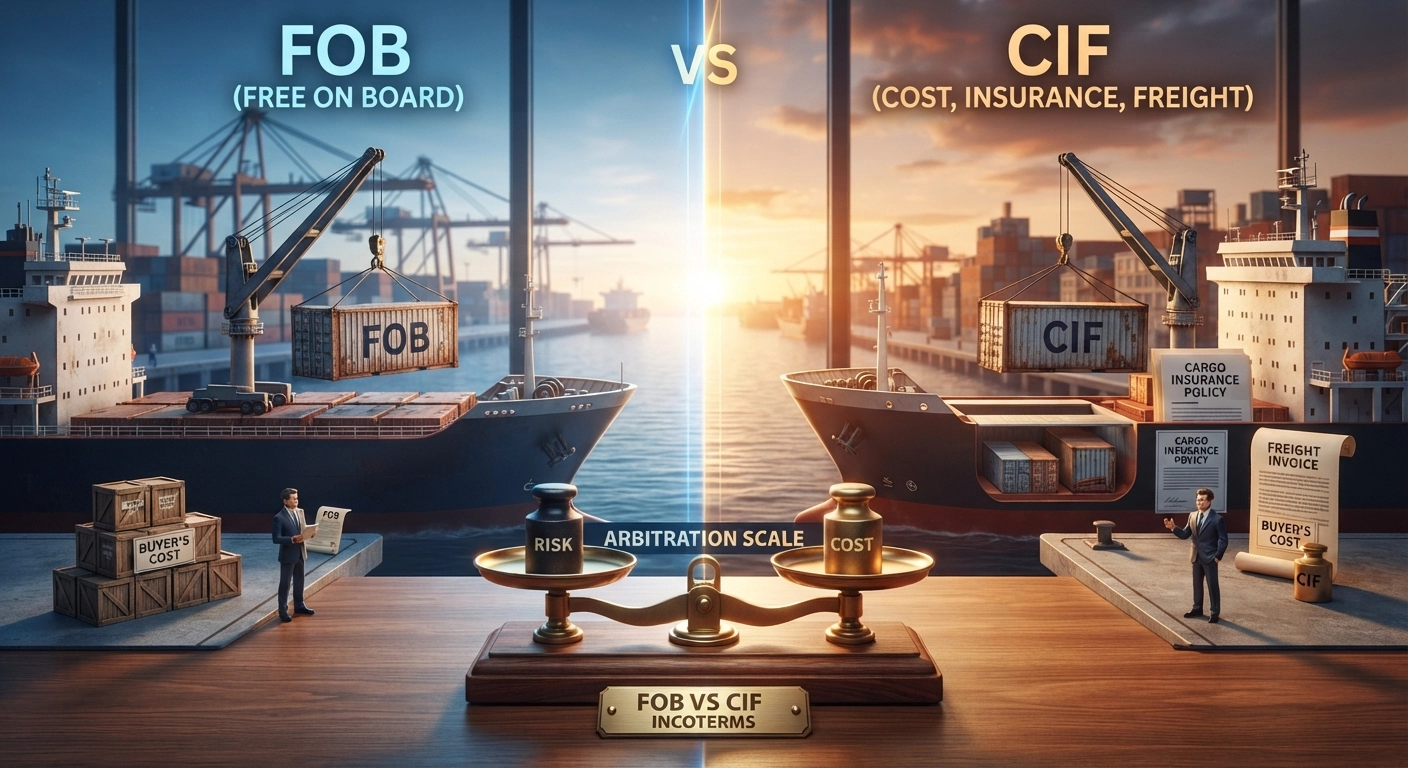
Most buyers and even experienced purchasing staff describe FOB and CIF the same way: "On FOB, we just get the goods to the port and we're done. CIF is more work for the seller, because they're responsible for getting the cargo safely across the ocean." That description is wrong in a way that can cost you money. Getting FOB and CIF right means separating three things that Incoterms treats very differently: who pays which cost, when risk actually transfers, and who legally owns the goods at any given moment.
Quick look
- FOB: the seller pays origin-country costs only. Freight and insurance from the port of loading onward are the buyer's expense.
- CIF: the seller pays origin-country costs plus freight and insurance through to the destination port, but that is a cost allocation, not a safety guarantee.
- Under both FOB and CIF, risk transfers at the exact same moment: when the goods are loaded on board the vessel at the port of origin.
- Incoterms rules govern cost and risk. They say nothing about who legally owns the goods. Title is decided separately, by the bill of lading and the payment terms.
Cost: The Part Everyone Gets Right
This is the one difference most people already understand correctly. Under FOB (Free on Board), the seller covers costs up to the point the goods are loaded on the vessel: inland trucking, export customs clearance, terminal handling charges. Ocean freight and marine insurance from that point on are the buyer's responsibility.
Under CIF (Cost, Insurance and Freight), the seller pays those same origin-country costs, then also arranges and pays for ocean freight and insurance through to the named destination port.
One detail buyers often miss: under CIF, Incoterms only requires the seller to buy minimum-coverage insurance, typically Institute Cargo Clauses (C). If your cargo is high-value, you need to explicitly request that the seller purchase broader coverage, such as Institute Cargo Clauses (A), and expect to pay the difference.
Risk: FOB and CIF Transfer Risk at the Same Point
Here is the misconception that actually costs people money. Buyers assume that because the seller is paying for freight and insurance under CIF, the seller is also carrying the risk all the way to the destination port. They are not.
Under both FOB and CIF, risk transfers from seller to buyer at the same moment: when the goods are loaded on board the vessel at the port of origin. If the ship sinks in the middle of the Pacific, the cargo loss is the buyer's risk, whether the shipment was quoted as FOB or CIF.
What CIF actually gives you is not protection, it is a paid-for insurance policy, with the buyer named as the beneficiary. If something happens at sea, the buyer is the one who files the claim directly with the insurance company, using the policy the seller purchased and transferred over, not the seller.
Title: Incoterms Does Not Decide Who Owns the Goods
The part buyers assume most often, and get wrong most often, is thinking that "risk transferred" means "the goods are now legally mine" or "the goods are now legally theirs." Incoterms does not touch ownership at all. Title, meaning who legally owns the cargo, is determined separately, by the bill of lading and by the payment terms attached to it, such as T/T or L/C.
Here is where that gap becomes a real problem. Say a seller ships CIF, with payment due by T/T against a copy of the bill of lading. The cargo catches fire and is destroyed at sea. Because risk had already transferred at the port of origin, the buyer is still legally obligated to pay the balance. But if the buyer decides to walk away and refuses to take up the documents, the seller is left holding the original bill of lading, meaning legal title to the goods, and title to a pile of ash is worth nothing. Trying to claim on the insurance is no simpler either: the seller is not the named beneficiary on that policy, and ends up in a weak position chasing a payment that may never come.
What This Means for Your Contract
Two habits fix most of the exposure described above.
First, name the exact port and the Incoterms version. Do not write "FOB Taiwan." Write "FOB Keelung Port, Incoterms 2020." A vague location invites a vague argument later about where risk actually transferred.
Second, do not treat "risk transfer" and "getting paid" as the same event. Structure the deal so that when risk transfers, insurance is actually in place and adequate for the cargo value, and so that title does not move into a counterparty's hands faster than the money does, for example through a reasonable deposit before shipment. A new buyer looks at freight cost. An experienced one looks at risk. The one who has already been burned once looks at title.
This is also why how a deal is structured on both ends matters as much as which Incoterm sits in the contract. Payment security and legal recourse depend on who is actually holding the funds and who signed the agreement, not just on which three letters appear next to the port name.
Common questions from buyers
If we buy CIF, doesn't that mean the seller is responsible until the goods reach our port?
No. The seller pays for freight and insurance to your port under CIF, but risk of loss or damage still transfers to you when the goods are loaded on the vessel at the origin port, the same point as under FOB.
Under CIF, who actually files a claim if the cargo is damaged at sea?
The buyer does. The seller purchases the insurance policy, but the buyer is the named beneficiary and is the one who submits the claim to the insurer.
Does paying for the goods mean we now legally own them?
Not automatically. Title is controlled by the bill of lading and the payment terms attached to it, not by Incoterms and not by the payment alone.
What is the one phrase we should never leave out of a shipping contract?
The named port and the Incoterms version, for example "FOB Keelung Port, Incoterms 2020," instead of a vague country-level term.
How much insurance does a seller have to buy under CIF?
Only the Incoterms minimum, typically Institute Cargo Clauses (C), unless you specifically request broader coverage and agree to cover the added cost.
Talk to us about how your shipment is structured
This page is part of Orientwings International's buyer resources. If you want a second set of eyes on how risk, payment, and title line up in an upcoming purchase, tell us what you are sourcing.
Related reading: Trade Knowledge, Importer of record, on the ground in Asia: our two companies, Supplier due diligence and transaction risk management, Payment collection and disbursement services.