
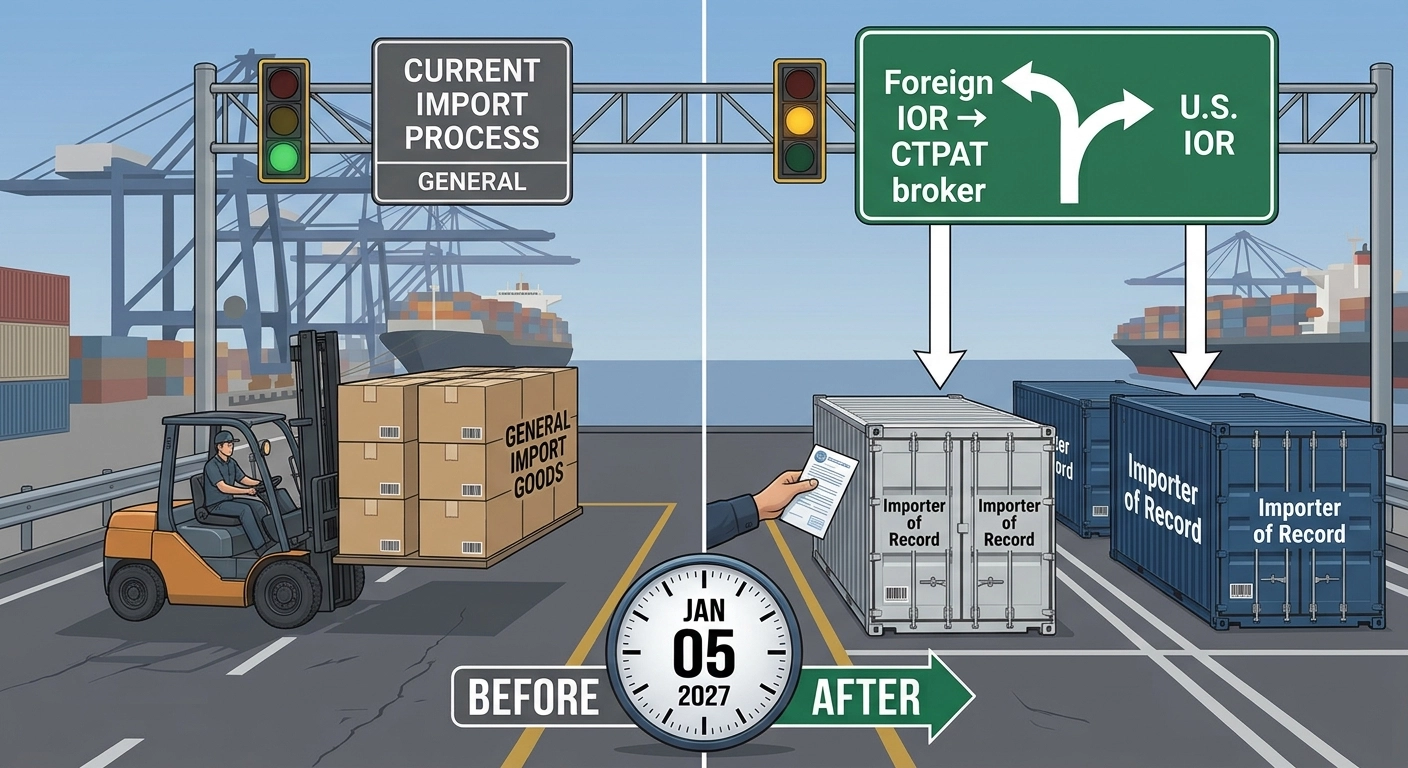
From January 5, 2027, every importer of record on a US entry has to declare whether it is a U.S. importer of record or a foreign importer of record. A company organized under US law does not automatically count as the U.S. kind. Foreign importers of record can still bring goods in, but only if they are validated under CBP's CTPAT program or file through a customs broker who is. The change comes from a CBP interim final rule published on November 6, 2026, and it matters most to overseas brands and sellers that import into the US in their own name or through a thin US entity.
What the Foreign Importer of Record Rule Is
The rule is titled "Heightened Requirements for Foreign Importers of Record." CBP published it in the Federal Register on November 6, 2026 (91 FR 69977) to carry out Executive Order 14411, "Strengthening Customs Enforcement," signed June 3, 2026. It adds a new Part 110 to Title 19 of the Code of Federal Regulations, which defines who is a U.S. importer of record and who is a foreign one.
- Effective date: January 5, 2027
- Public comments: due by January 5, 2027
- Customs brokers: expected to be in full compliance by May 6, 2027
Because it is an interim final rule, it takes effect before the comment period ends. CBP may change it in a later final rule.
Who Counts as a U.S. Importer of Record
Under the new 19 CFR 110.2(a), a U.S. importer of record is either:
- an individual who is a US citizen or lawful permanent resident; or
- an entity that is organized under US law, is located in the United States, and at all times either (i) has at least 51% of its beneficial owners who are US citizens or lawful permanent residents and have control of the entity, or (ii) directly owns a significant amount of unencumbered real property in the United States.
A beneficial owner is an individual who, directly or indirectly, exercises substantial control over the entity or owns or controls at least 25% of its ownership interests. Any importer of record that does not meet these tests is a foreign importer of record under the new 19 CFR 110.3.
In practice, a US subsidiary or a newly formed LLC that is owned and controlled by people who are not US citizens or permanent residents, and owns no US real estate, falls on the foreign side of the line.
How CBP Checks Whether an Entity Is "Located in the United States"
CBP says it will look at the size and scale of the entity's operations and whether it is an instrumentality of a foreign manufacturer without a substantial US presence. The rule lists criteria CBP may consider, including whether:
- the principal place of business is in the United States;
- the entity has a physical US presence where substantial business is done, such as paying employees, generating revenue or operating retail locations;
- it holds sufficient unencumbered physical domestic assets;
- it directly owns a sufficient amount of unencumbered US real property;
- its gross sales generally exceed its cost of goods sold, and it is structured to generate its own profit;
- it is sufficiently capitalized.
To verify a declaration, CBP may ask for proof of citizenship or permanent residence, corporate charters, financial statements and records, purchase receipts or documents of title.
What Changes for Foreign Importers of Record
A foreign importer of record may enter goods for consumption only if it is a CTPAT validated participant, or uses a licensed customs broker that is CTPAT validated. This applies to formal entries and to informal entries filed on CBP Form 3461 or 7501. CBP has also asked for comments on going further: if it finds the CTPAT requirement is not enough, it may prohibit informal entries filed by or for foreign importers of record altogether.
CTPAT validation is a process, not a form. An overseas seller that is not validated today and plans to stay its own importer of record will need a CTPAT validated broker from January 5, 2027.
What Changes for Customs Brokers and Every Importer
At the time of filing an entry and entry summary, the importer of record must declare whether it qualifies as a U.S. importer of record. Before filing on behalf of a client that declares U.S. importer of record status, a customs broker must verify that the client meets the qualifications. Where a broker that is not CTPAT validated files for such a client, the broker must identify the principal on the power of attorney and declare that the principal would meet the U.S. importer of record test, and that principal must have a CBP Form 5106 on file.
Four Questions for Overseas Brands Before January 5
- Who is the importer of record on your goods today? Your own company, a US subsidiary, your buyer, or a third party?
- Does that party meet the U.S. importer of record test? Check ownership and control, not just where the company is incorporated.
- If it is a foreign importer of record, is there a CTPAT path? Ask your customs broker whether it is CTPAT validated and how it will file from January 5.
- Can the paperwork be produced on request? Ownership records, corporate documents and financial statements may be asked for during verification.
Foreign Importer of Record Rule: Common Questions
Is a company incorporated in Delaware or California automatically a U.S. importer of record?
No. It also has to be located in the United States and meet either the 51% US beneficial ownership and control test or the US real property test.
Can a foreign importer of record still import after January 5, 2027?
Yes, if it is CTPAT validated or files through a CTPAT validated licensed customs broker. CBP has asked for comments on whether to stop informal entries for foreign importers of record.
How does this relate to the importer of record numbers CBP voided in 2026?
It is a separate step. The earlier action voided numbers registered with inaccurate Form 5106 data; see Importer of Record Numbers Voided. The new rule changes who may act as importer of record at all.
Where can comments be filed?
Through the Federal eRulemaking Portal, using the docket number in the Federal Register notice, by January 5, 2027.
For the bond side of an import, see Customs Bond Types and Customs Bond Cost. Importing into the US in 2027? Tell us what you are importing.
Sources
- U.S. Customs and Border Protection, "Heightened Requirements for Foreign Importers of Record", interim final rule, Federal Register Vol. 91, No. 214, p. 69977, November 6, 2026, FR Doc. 2026-22735 (official PDF; checked November 15, 2026)
- Executive Order 14411, "Strengthening Customs Enforcement", signed June 3, 2026, Federal Register Vol. 91, p. 35125, June 10, 2026 (checked November 15, 2026)
This article is general information, not legal advice. Confirm how the rule applies to your shipments with a licensed customs broker or a US customs attorney.