
Most buyers treat the ocean freight number on a quote as the total cost of getting a shipment home. It rarely is. Landed cost is the full amount a shipment actually costs by the time it clears US customs and reaches your warehouse door, and several of the line items inside it rarely show up on the freight quote at all.
Quick look
- Landed cost covers everything from the factory to your door, not just the ocean or air freight rate on the quote.
- US Customs and Border Protection (CBP) charges a Merchandise Processing Fee of 0.3464% of declared value on formal entries, with a minimum of $33.58 and a maximum of $651.50 for fiscal year 2026.
- Ocean shipments also carry a separate 0.125% Harbor Maintenance Fee; air shipments do not.
- Entry filing, terminal handling, and inland trucking from the port to your address are usually priced separately from the base freight rate.
Base Freight Is Not Your Landed Cost
A freight quote typically prices one leg of the journey: the ocean or air movement from the origin port to the destination port or airport. It usually stops there. Everything that happens after the container or air waybill arrives in the United States, the customs entry, government fees, and the trip from the port to your actual address, is a separate set of charges that buyers frequently do not ask about until the final invoice arrives.
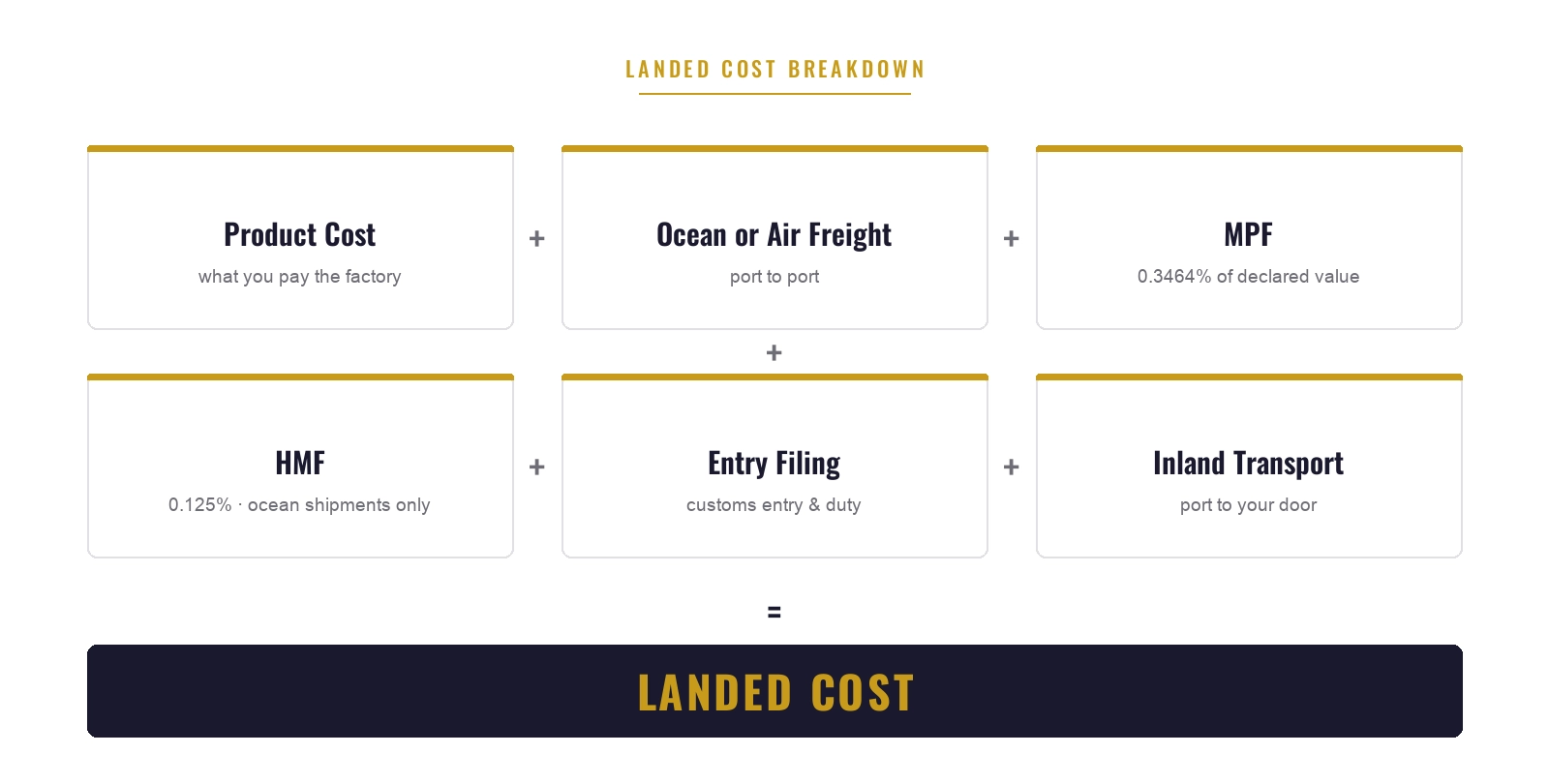
Landed cost is the sum of all of it: the product cost, the freight, the customs duties and fees, the entry filing service, and the inland transportation to the final delivery address. Leaving any of these off a budget does not make them disappear, it just moves the surprise to later in the shipment.
The Two US Customs Fees Almost Nobody Budgets For
Two federal fees apply to most commercial imports, and neither one is a tariff. Both are calculated on the declared value of the goods, not on the freight or insurance cost.
The Merchandise Processing Fee (MPF) applies to formal entries at an ad valorem rate of 0.3464% of the goods' declared value. For fiscal year 2026, effective October 1, 2025, CBP set the minimum MPF at $33.58 and the maximum at $651.50 per entry. This fee applies whether the shipment arrives by ocean or by air.
The Harbor Maintenance Fee (HMF) applies only to cargo that moves by ocean vessel, at a rate of 0.125% of declared value. Air shipments are not subject to it. The HMF rate has stayed the same since it was established under 26 U.S.C. § 4461, and it is billed separately from the MPF.
Neither fee appears on an ocean or air freight quote, because neither one is a freight charge. They are billed as part of the customs entry, which is exactly why buyers who only budget the freight number are caught off guard.
Entry Filing and the Charges Between the Port and Your Door
Filing the customs entry itself, checking the tariff classification, declared value, and country of origin, and remitting the MPF, HMF, and any duty owed, is a service with real work behind it, and it is priced separately from ocean or air freight. On the shipments we purchase and import ourselves, this filing is handled under our own US company as importer of record, as described on our International Procurement and Preliminary Supplier Assessment page.
Once a shipment clears customs, it still has to physically move from the port to your address. Terminal handling charges cover moving the container off the vessel and through the port. Drayage or inland trucking covers the leg from the port to a warehouse or final delivery address, and that leg is routinely missing from an ocean freight quote that only covers port to port.
Demurrage and detention are two more charges that can appear at this stage if a container sits at the port or is not returned on time. We have covered how those two charges work, and how to avoid them, in our earlier guide to FCL and LCL hidden cost traps
Common questions from buyers
Does landed cost include the customs duty itself?
Yes. Duty is one line inside landed cost, alongside the product cost, freight, MPF, HMF, entry filing, and inland transportation. Duty alone is not the total.
Is the Merchandise Processing Fee the same as a tariff?
No. The MPF is a fixed-percentage user fee CBP charges to process the entry, separate from any tariff or duty rate that applies to the product itself.
Does the Harbor Maintenance Fee apply to air freight?
No. The HMF only applies to cargo that moves by ocean vessel. Air shipments are subject to the MPF but not the HMF.
Why didn't my freight quote mention any of these fees?
Because a freight quote typically prices the ocean or air movement only. Customs fees, entry filing, and inland trucking from the port to your address are usually quoted as separate line items, not folded into the freight rate.
What should I ask for before I approve a quote?
Ask whether the number in front of you includes the MPF and, for ocean shipments, the HMF; whether it includes entry filing; and whether inland transportation to your final address is included or billed separately.
Ask us what is in your landed cost quote
This is the kind of question our International Procurement and Preliminary Supplier Assessment service is built to answer before a shipment ships, not after the invoice arrives. If you want a full breakdown of what a specific shipment will actually cost by the time it reaches your door, tell us about the shipment.
Related reading: Trade Knowledge, FOB vs CIF: Cost, Risk, and Title Under Incoterms 2020, Ocean Freight: FCL, LCL, and the Hidden Cost Traps, International Procurement and Preliminary Supplier Assessment.